Vault values
Unlike on the other events, where we have skills and letters values and composition requirements and bonus rules, on vault we have simply a set of predetermined start values.
You can check out the full list of vaults and their values, but the most pressing issue on vault is the quest to have a 10.0 start value. Because the omnipresent Yurchenko full is valued at 9.95, having a 10.0 SV can provide a decisive advantage. A lineup of all 10.0 vaults would begin with a margin of .250 over a lineup of all Yurchenko fulls.

Here is a list of some 10.0-value vaults that you may or may not see in NCAA. The golden geese of vaulting.




Deductions
With the values set, all we have left to deal with are the deductions. The most important thing you need to know about NCAA deductions is ‾\_(ツ)_/‾. Keep that in mind at all times.
Landing Steps
The smallest landing deduction the judges can take is .05. This is supposed to be reserved for only the very smallest of movements, like when a gymnast allllmost sticks but her momentum forces that little scoot backward, or she has that tiny hop in place where the feet don’t even really come up but it’s also not a stick. That’s what the .05 is for, though in practice what constitutes very small movement tends to be evaluated loosely, especially for those teams going 9.9 for every routine, and a lot of actual landing steps tend to get away with just .05 instead of a full tenth.
Any clear step where we see daylight between the feet is supposed to be .10. If the step is a yard or larger, that goes to a flat .20 for each step individually. There’s a maximum deduction of .40 total for landing steps, even if you’re just running out of the gym and never come back. And good for you.
CHANGE FOR 2024 ALERT: Miracle of miracles, an intermediate step deduction has been added. This allows the judges to take .15 for a single medium step, larger than a .10 normal walking step but not a full yard for .20.
Finish Position
CHANGE FOR 2024 ALERT: The biggest change in college gymnastics judging in 2024 comes from the addition of a .05 deduction on vault, bars, and beam for not holding a “finish position” for at least 1 second. Because what college gymnastics really needs is to sound more like a cotillion. Very modern and fun.
The finish position is defined as having your legs straight and your hands up in the air and must be shown facing the same direction that you landed. All other deductions that already existed still apply, but now after you’re done stepping or sticking, you have to stop everything and go “ALL DONE” (*yelling ALL DONE is not required, just encouraged), frozen in an extended position for 1 second, otherwise you lose .05.

After holding the finish position for 1 second, gymnasts do not have to turn and salute the judges, but they physically won’t be able to help themselves because of their entire lives of being murdered if they didn’t.
So, why is this a thing now? It exists to try to curb the epidemic of “college sticks.” The college stick is a term invented by grimy little jackals like me to describe the situation where a college gymnast will realize that there is zero chance in the holographic universe that she’ll be able to hold her landing under control for a real stick, so she just pretends like she already stuck hours ago and you simply missed it. She’ll land and then immediately slide-step and turn toward the judges to salute them while at the same time celebrating and running away from this definite stick that happened. Even though at no point was any actual stopping or landing control shown.

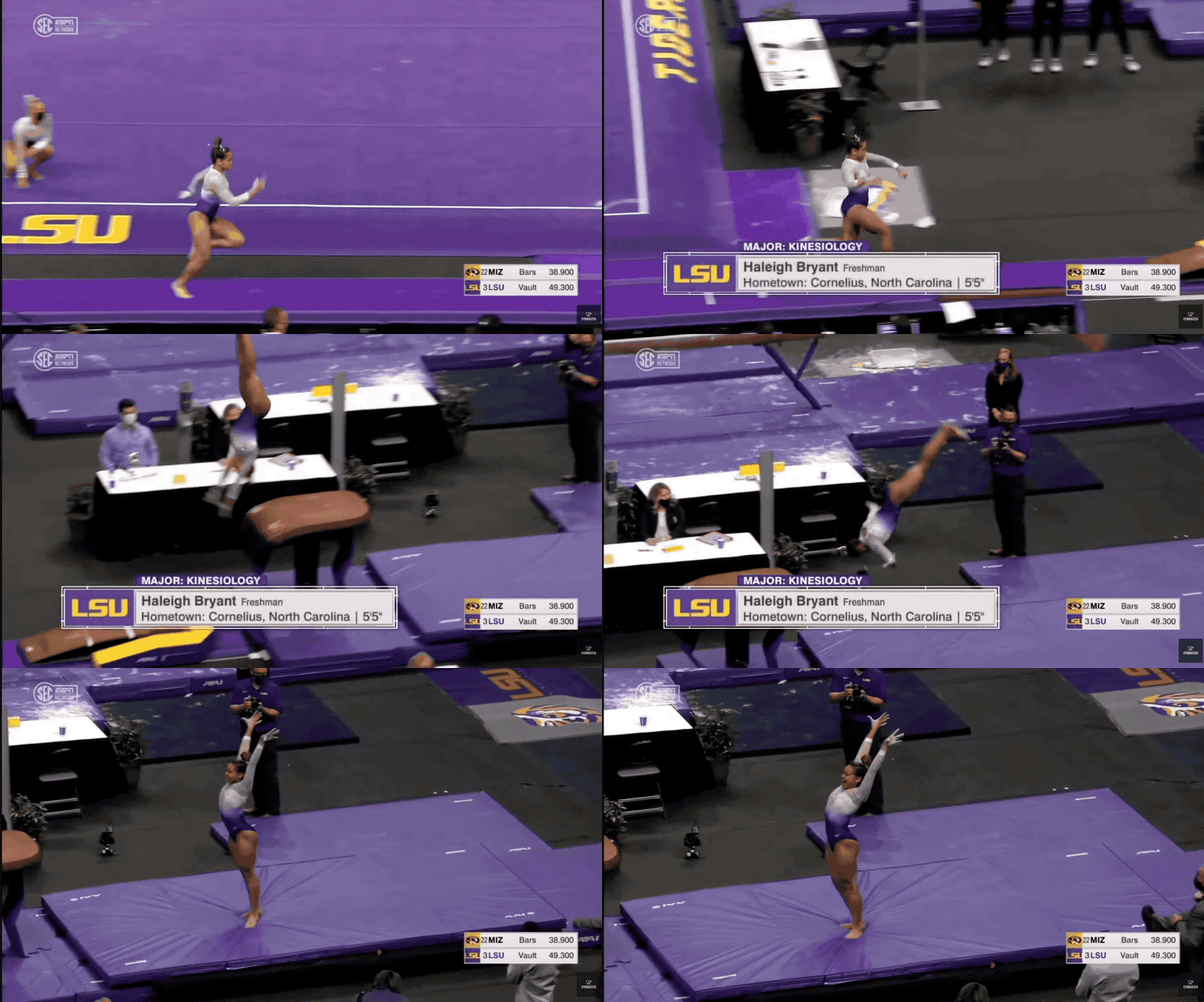
This vault received a 10.000 from one judge and a 9.950 from the other last season. In 2024, this vault absolutely cannot receive a 10.000 because of not holding that arms-up finishing position, which would also hopefully serve to emphasize the actual lack of control on landing to ensure that got deducted as well. At least, that’s the whole plan behind making finish position a thing.
Landing Position
“Landing short”—for instance, not completing the full layout flip on a Yurchenko layout 1.5 and landing with the hips well behind the feet for a step back—is its own deduction in addition to any steps.
CHANGE FOR 2024 ALERT: This used to be a flat .10 deduction and has been changed to an “up to .10” deduction, meaning a judge could decide to take only .05 instead of .10 if it’s not egregious, but could also take .10 if it is egregious. For the top teams, this probably doesn’t make a difference because the judges weren’t taking that flat .10 when they were supposed to anyway.
Deductions for short landings are why you will typically see Yurchenko fulls with a step forward score lower than Yurchenko fulls with an equivalent-sized step backward. The vault with a step backward will have been fully completed and landed with the chest up and would then incur only the step deduction (in the landing department at least). The vault with a step forward, however, was not 100% completed because the step forward indicates that the gymnast came into the mat short, probably also having to pike down and lose the layout shape. All of which are additional deductions.
In terms of a deep landing, gymnasts are expected to safely absorb the landing into some degree of squat for no deduction.
CHANGE FOR 2024 ALERT: Previously, when the hip and knee joints were horizontal with each other, that was a .10 deduction. Now, that is no deduction. Deductions for squat begin only when the hip joint is lower than the knee joint on landing, progressing from .10 for a bit lower to .30 for a butt-scraper landing. Judges have been instructed that the deep landing should be evaluated by the position of the hip joint rather than the lower border of the thigh.
Piked shape and bent knees
Most vaults you see in NCAA will attempt a layout position. On those vaults, the best athletes will show a completely straight body shape throughout, like a muscly little broomstick. Ideally, gymnasts will go even further than that and show a slightly open shape with a little arch toward the end of the vault, going beyond the straight position just because they can, Shannon Miller-style.

You’ll hear about the best vaulters “flaring” a vault, which means they’re opening and extending their arms at the end to slow their rotation coming in for landing. This both looks pretty and provides evidence of a gymnast who has way more than enough time to complete her vault and land in a non-Hunchback-of-Notre-Dame shape, so she has to slow herself down to avoid overdoing it.
Those who exhibit a closed hip angle—less than 180 degrees—on a layout vault will face a deduction. This is typically a small deduction, depending on the degree of the angle and when it occurs. If the pike is significant or present throughout the entire vault (not just coming in for landing), gymnasts will be docked more than .05. When the chest is just a little bit forward on landing at the very end but everything else is fine, that often escapes without a deduction.
When a gymnast could eat a full dinner off her knees on landing, that’s when body position becomes a major problem and moves into .10+ territory.
Layout vaults are expected to exhibit straight legs, without any bent knees or hint of vestigial tucking. A “soft” position means the legs have a little bend in the knee throughout, which is typically a .05 but can increase based on severity.
Amplitude
Height/amplitude is evaluated far more critically on vault than on the other events. Gymnasts need to show repulsion off the vaulting table (going UP and OUT, not just out) and need to complete the vault while still in a high position in the air. Otherwise, they’ll come in short and be in line for the landing deductions discussed above, as well as an amplitude deduction. Deductions don’t exist in a vacuum. One creates the next.
There is no specific height standard that gymnasts are expected to reach. Instead, a vault that avoids an amplitude deduction is one where the entire vault, all necessary flipping and twisting, is completed with at least the chest, if not the entire body, above the height of the vaulting table. Then, as the gymnast passes the height of the vaulting table, all she has to do is prepare for landing.


The height deductions get quite intense for flat vaults that shoot out horizontally. These are not the little .05s we see for minor form breaks. A vault that lacks height is considered a much more significant error than a vault with soft knees or small landing movement. The judges are actually able to take up to .50 for height, which they never come close to doing because college scoring, but there’s a lot more freedom to deduct for height and .15 or .20 is not an unusual deduction for a mostly horizontal vault.
Meanwhile, “heighth” is not a word.
Distance
As mentioned above, vaults are expected to go both UP and OUT, so a vault that goes only up—and not out very far from the vault—will be deducted with nearly the same severity as one that goes only out, and not up.
Distance, too, is judged without a specific reference point, which makes distance deductions pretty ambiguous. “Did she go far?” is not an acceptably distinct standard for judging, but that’s more or less where we are.
Basically, gymnasts are expected not to make the judges scared that they’re going to hit their head on the vaulting table. If a judge screams at your vault, that’s probably bad. At minimum, gymnasts need to be far enough away that hitting themselves on the vault cannot physically happen. Ideally, a gymnast would have enough room to be able to lie down flat on the mat between her landing position and the vault.
Direction
Gymnasts are expected to land in line with the center of the vaulting table, not deviating too far to either side. The landing mat will have lines on either side to act as a guide for the judges to evaluate direction.
Now, this deduction is still a vague one with the judges allowed to take “up to .30” for direction. There is no flat, mandatory deduction amount for a gymnast landing over the line, but the lines are supposed to serve as a reminder that something should be taken. College gymnastics evaluates direction deductions based only on where the gymnast initially lands, not where she then steps after landing.
Leg separations
On the topic of deductions that are not evaluated as harshly as they could be in NCAA gymnastics, leg separations on vault. The legs are supposed to be pasted together in the air on all vaults. To be actually deducted in college, however, leg separations must be somewhat obvious—i.e., we’re seeing actual daylight between the legs.
A minor crossing of the feet in the air is one of those things that’s technically a deduction but will almost always be forgiven without penalty in college gymnastics, along with most deductions in repulsion (the time when in contact with the vaulting table). Those go into a category of deductions that appear in the annual NAWGJ educational materials but suddenly disappear onto the wings of the wind when big-time-exciting meets happen. But in theory, we’re supposed to be looking at .05s for things like a leg separation in pre-flight (the time between hitting the springboard and contacting the table) and a noticeable shoulder angle, bent elbows, or excessive back arch in repulsion.
Those issues aren’t typically deducted as much as they could be in and of themselves, though they often lead to a lack of amplitude and distance, which is where gymnasts will be penalized.