WTF is College Gymnastics Scoring – Vault (2023 Edition)

Before the NCAA season begins, it’s time for the now-annual venture into the murky world of NCAA scoring for those who might want to know a little more about what’s actually going on behind that bonkers 9.950 that just got thrown. Fair warning: you’ll be happier if you don’t.


Vault values

Unlike on the other events, where we have skills and letters values and composition requirements and bonus rules, on vault we simply have a set of predetermined start values.

You can check out the full list of vaults and their values, but the most pressing issue on vault is the quest to have a 10.0 start value. Because the omnipresent Yurchenko full is valued at 9.95, having a 10.0 SV can provide a decisive advantage. A lineup of all 10.0 vaults would begin with a margin of .250 over a lineup of all Yurchenko fulls.

Here is a list of some 10.0-value vaults that you may or may not see in NCAA. The golden geese of vaulting.

NCAA 10.0 Vaults
Yurchenko 1.5
Yurchenko 2/1
Yurchenko 2.5
Yurchenko 1.5 tucked
Round-off 1/2 on, front tuck 1/2
Round-off 1/2 on, front pike
Round-off 1/1 on, back pike
Tsukahara 1/2
Tsukahara 1/1
Handspring pike 1/2
Handspring tuck 1/1
FHS, Handspring front pike

CHANGES FOR 2023

We have a couple vault value changes for the 2023 season, some of which might even be relevant or medium-significant. The handspring front tuck 1/2 was raised from 9.90 to 9.95—now the same value as the Yurchenko layout full. For those who aren’t quite ready to throw the 10.0-start handspring front pike 1/2, there is now a lower-SV alternative that’s still valuable for competition.

The round-off full-on back tuck has been lowered in value from 10.00 to 9.95 because of the consideration that the piked version of this vault is harder and therefore should be more valuable (10.00) than the tucked version (9.95).

Deductions

With the values set, all we have left to deal with are the deductions. Just those. The most important thing you need to know about NCAA deductions is ‾\_(ツ)_/‾. Keep that in mind at all times.

Landings

The smallest landing deduction the judges can take is .05. This is supposed to be reserved for only the very smallest of movements, like when a gymnast allllmost sticks but her momentum forces that little scoot backward, or she has that tiny hop in place where the feet don’t even really come up but it’s also not a stick. That’s what the .05 is for, though in practice what constitutes very small movement tends to be evaluated loosely, especially for those teams going 9.9 for every routine, and a lot of landing issues tend to get away with just .05 instead of a full tenth.

As written, the rule states that when the entire feet are sliding or lifting off the floor to join, that’s when the deduction moves to the .10 territory, which also encompasses any clear step where we see daylight between the feet. If the step is larger than a yard, that’s supposed to be a flat .20 for each step individually (maximum .40).

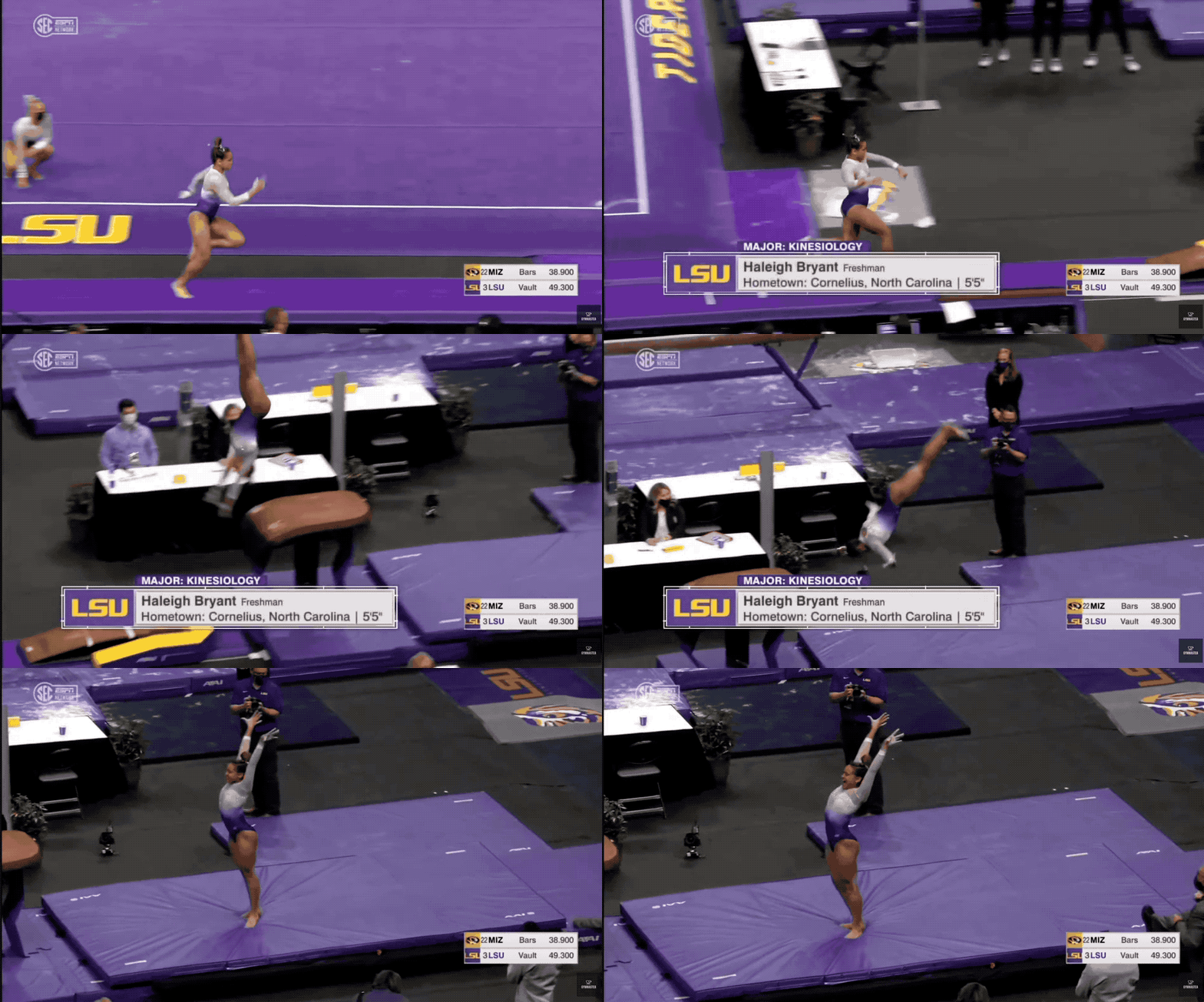
What is a stuck landing? A stuck landing is when the feet hit the ground and then do not move at all in any way. That—and only that—is a stuck landing. A small rebound upward in place is not a stick.

So, what is a “college stick”? College stick is a term invented by grimy little jackals like me to describe the situation where a college gymnast—fully of newly adult savvy and three days of Acting I before she dropped it because there’s no way she could maintain that schedule—will realize that there is zero chance in the holographic universe that she’ll be able to hold her landing under control for any length of time, so she just pretends like she already stuck hours ago and you simply missed it. Like when your parents would ask whether you already washed your hands before dinner and you were like, “…yes.” The gymnast will land and then pretend like the absolutely necessary step she physically had to take afterward is merely a post-stick celebration, just like all the cool kids do after their definitely real sticks that happened.

The college stick fools no one, even judges who really want to give you that 9.950, but how much to deduct for that college-stick-step is a gray area. We’ll often see a .05 deduction given (even though the step taken would normally warrant .10) as some manner of reward for almost sticking. 

“Landing short”—for instance, not completing the full layout flip on a Yurchenko layout 1.5 and landing with the hips well behind  the feet for a step back—is supposed to receive a flat .10 in addition to any stepping deductions.

This is probably the biggest pet peeve that NCAA judges secretly have about other NCAA judges: that the short Yurchenko layout 1.5 showing a step back cannot mathematically score higher than 9.800 because you have to take the .10 for landing short and you have to take the .10 for the step. And we don’t always see that happen.

That’s also why you will typically see Yurchenko fulls with a step forward score lower than Yurchenko fulls with an equivalent-sized step backward. The vault with a step backward will have been fully completed and landed with the chest up and would then incur only the step deduction (in the landing department at least). The vault with a step forward, however, was not 100% completed because the step forward indicates that the gymnast came into the mat short, probably also having to pike down and lose the layout shape. All of which are additional deductions.

In terms of a deep landing, gymnasts are expected to safely absorb the landing into some degree of squat for no deduction, but when the hip joint and the knee joint are horizontal with each other, that’s supposed to be .10, progressing up to .30 based on the severity of the deep landing. Judges have been instructed that the deep landing should be evaluated by the position of the hip joint rather than the lower border of the thigh.

Piked shape and bent knees

Most vaults you see in NCAA will attempt a layout position. On those vaults, the best athletes will show a completely straight body shape throughout, like a muscly little broomstick. Ideally, gymnasts will go even further than that and show a slightly open shape with a little arch toward the end of the vault, going beyond the straight position just because they can, Shannon Miller-style.

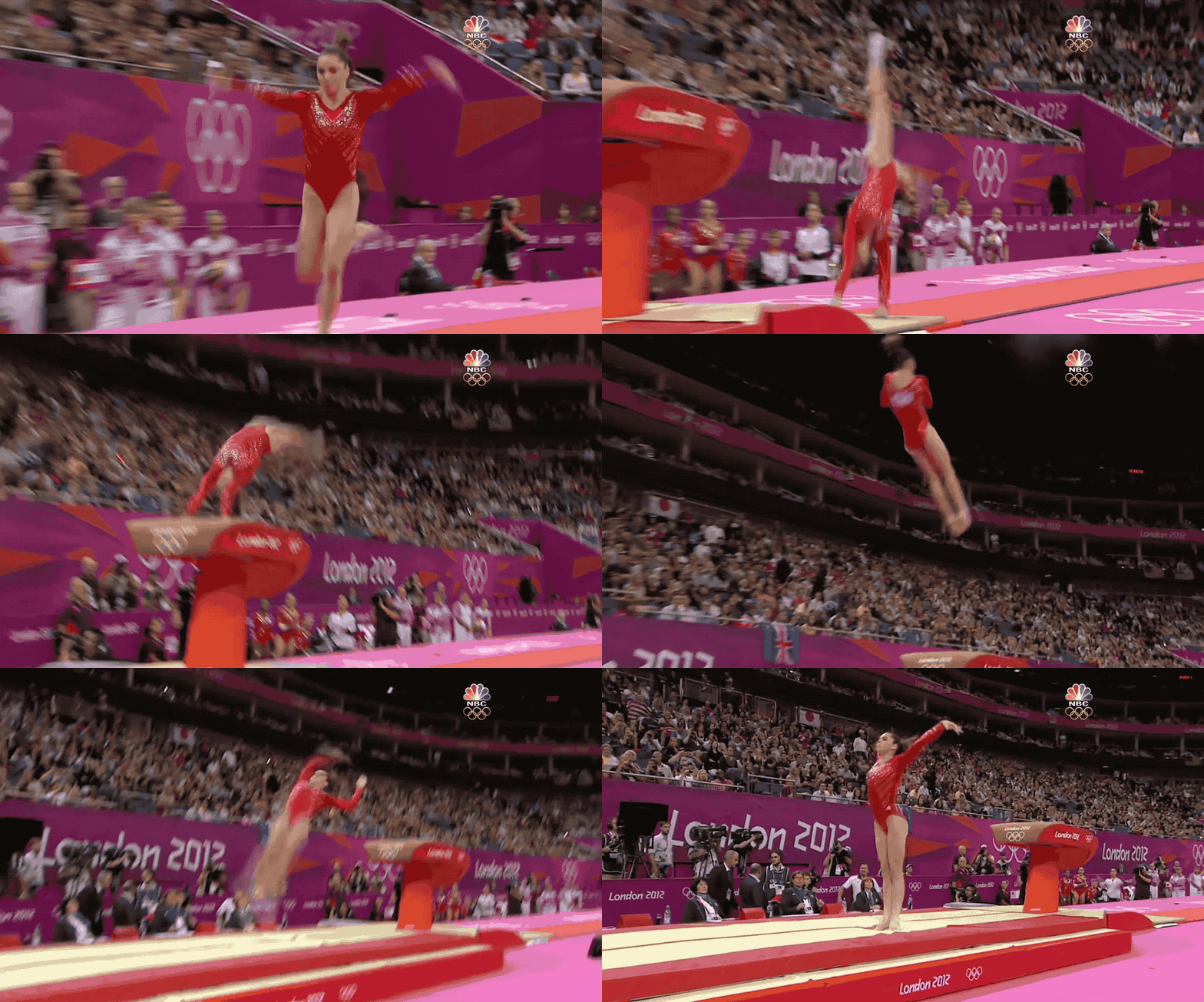
If performed in NCAA, the above vault should receive a perfect 9.950 (the maximum for a Yurchenko full).

You’ll hear about the best vaulters “flaring” a vault, which means they’re opening and extending their arms at the end to slow their rotation coming in for landing. This both looks pretty and provides evidence of a gymnast who has way more than enough time to complete her vault and land in a non-Hunchback-of-Notre-Dame shape, so she has to slow herself down to avoid overdoing it.

Those who exhibit a closed hip angle—less than 180 degrees—on a layout vault will face a deduction. This is typically a small deduction, depending on the degree of the angle and when it occurs. If the pike is significant or present throughout the entire vault (not just coming in for landing), gymnasts will be docked more than .05. When the chest is just a little bit too forward on landing at the very end but everything else is fine, that often escapes without a deduction.

When a gymnast could eat a full dinner off her knees on landing, that’s when body position becomes a major problem and moves into .10+ territory.

Vaults that are intended to be piked are held to a similarly strict shape standard, but in their case the requirement is showing a 90-degree hip angle instead of 180. Tucked vaults need to show less than a 90-degree hip angle and less than a 90-degree knee angle.

Both layout and piked vaults are expected to exhibit straight legs, without any bent knees or hint of vestigial tucking. A “soft” position means the legs have a little bend in the knee throughout, which is typically a .05 but can increase based on severity.

Amplitude

Height/amplitude is evaluated far more critically on vault than on the other events. Gymnasts need to show repulsion off the vaulting table (going UP and OUT, not just out) and need to complete the vault while still in a high position in the air. Otherwise, they’ll come in short and be in line for the landing deductions discussed above, as well as an amplitude deduction. Deductions don’t exist in a vacuum. One creates the next.

There is no specific height standard that gymnasts are expected to reach. Instead, a vault that avoids an amplitude deduction is one where the entire vault, all necessary flipping and twisting, is completed with at least the chest, if not the entire body, above the height of the vaulting table. Then, as the gymnast passes the height of the vaulting table, all she has to do is prepare for landing.

The height deductions get quite intense for flat vaults that shoot out horizontally. These are not the little .05s we see for minor form breaks. A vault that lacks height is considered a much more significant error than a vault with soft knees or small landing movement. The judges are actually able to take up to .50 for height, which they never come close to doing because college scoring, but there’s a lot more freedom to deduct for height and .15 or .20 is not an unusual deduction for a mostly horizontal vault.

Meanwhile, “heighth” is not a word.

Distance

As mentioned above, vaults are expected to go both UP and OUT, so a vault that goes only up—and not out very far from the vault—will be deducted with nearly the same severity as one that goes only out, and not up.

Distance, too, is judged without a specific reference point, which makes distance deductions pretty ambiguous. “Did she go far?” is not an acceptably distinct standard for judging, but that’s more or less where we are.

Basically, gymnasts are expected not to make the judges scared that they’re going to hit their head on the vaulting table. If a judge screams at your vault, that’s probably bad. At minimum, gymnasts need to be far enough away that hitting themselves on the vault cannot physically happen. Ideally, a gymnast would have enough room to be able to lie down flat on the mat between her landing position and the vault.

Direction

CHANGE FOR 2023

Gymnasts are expected to land in line with the center of the vaulting table, not deviating too far to either side. For 2023, college gymnastics has finally added lines on the vault landing mat as a guide for the judges to evaluate the direction deduction.

Now, this deduction is still a vague one with the judges allowed to take “up to .30” for direction. There is no flat, mandatory deduction amount for a gymnast landing over the line, but the lines should at least serve to remind everyone that something should be taken.

College gymnastics evaluates direction deductions based only on where the gymnast initially lands, not where she then steps after landing.

Leg separations

Also on the topic of deductions that are not evaluated as harshly as they could be in NCAA gymnastics, leg separations on vault. The legs are supposed to be pasted together in the air on all vaults. To be actually deducted in college, however, leg separations must be somewhat obvious—i.e., we’re seeing actual daylight between the legs.

A minor crossing of the feet in the air is one of those things that’s technically a deduction but will almost always be forgiven without penalty in college gymnastics, along with most deductions in repulsion (the time when in contact with the vaulting table). Those go into a category of deductions that appear in the annual NAWGJ educational materials but suddenly disappear onto the wings of the wind when big-time-exciting meets happen. But in theory, we’re supposed to be looking at .05s for things like a leg separation in pre-flight (the time between hitting the springboard and contacting the table) and a noticeable shoulder angle, bent elbows, or excessive back arch in repulsion.

Those issues aren’t typically deducted as much as they could be in and of themselves, though they often lead to a lack of amplitude and distance, which is where gymnasts will be penalized.

2023 Oklahoma Sooners

[wptb id=95684]

Ranking History
2022 – 1st
2021 – 2nd
2020 – 1st
2019 – 1st
2018 – 2nd
2017 – 1st
2016 – 1st
2015 – 3rd
2014 – 1st
2013 – 2nd
2012 – 7th

Where 2022 Finished…

The 2022 season brought Oklahoma its fifth national title in the last eight seasons (excluding 2020), and while it’s challenging to set records for all-time finishes when compared to the Utah teams of the 80s through mid-90s and the Georgia teams of the mid 90s through 2009—where five titles in a decade was like “must try harder”—Oklahoma is as close as the modern college gymnastics landscape will come to having the dominant dynasty. If no one else in the final has the meet of their lives, Oklahoma wins.

And—on paper at least—the team is getting deeper in its collection of possible 9.9s in 2023. It should be harder to beat Oklahoma this year than it was last year.

Gains and Losses

LOSTGAINED
Carly Woodard – BB, FXFaith Torrez
Karrie Thomas – UB (BB)Ava Siegfeldt
Vanessa Deniz – (UB, BB, FX)Caitlin Smith (JAN)
Emma LaPinta – (FX)
Moorea Linker – (VT, UB, FX)

The New Ones

Adhering to the general national theme, Oklahoma has a pretty small class of new athletes. Still, in former elites Faith Torrez and Ava Siegfeldt, OU should have two major contributors on its hands who provide far more than the three lineup routines that were lost after 2022. 

Torrez is believable for lineups on at least three events herself, though her most significant apparatuses should be beam and floor. On beam, we have seen her continuing to train her signature back tuck full, and on floor, Torrez retained her DLO when she dropped back from elite to L10 and looks to provide some necessary back-of-the-lineup big. Vault is the one that could be a maybe since Torrez went with the Yfull in L10 and Oklahoma is a 10.0s-or-nothing team, but she did have a solid DTY in elite.

Siegfeldt also wouldn’t surprise if she made the lineup on any apparatus (though she did not compete the AA at Oklahoma’s last public intrasquad). On vault and floor in elite, Siegfeldt had a viably college Y1.5 that could add to the mix, and her DLO is an appealing prospect to inject some more difficulty into that lineup. Whether there are actually any lineup openings could determine whether we see Siegfeldt on bars and beam, but she has plenty of college potential there as well. 

Joining the team in January will be Caitlin Smith, not to be confused with the entirely separate Caitlin Smith who was on LSU’s roster for 30 seconds a couple years ago. Smith has some strong Devo results to her name, including an AA victory at nationals as a junior in 2019, and with good leg position on a loso series on beam and a Shap 1/2 on bars, she seems ready.

Event by Event

VAULT

2022 Event Ranking: 4

Lineup locks: Jordan Bowers, Katherine Levasseur, Olivia Trautman, Allie Stern, Danielle Sievers
Lineup options: Danae Fletcher, Audrey Davis, Ava Siegfeldt, Audrey Lynn, Faith Torrez, Sheridan Ramsey, Meilin Sullivan

The 10.0-start life should be alive and well for Oklahoma in 2023, and with the entirety of the lineup that went 49.6625 in last year’s national championship returning, there wouldn’t seem to be much urgency to switch things up. The Bowers, Levasseur, Trautman, Stern, Sievers, Fletcher lineup that competed that day sounds like a solid plan to me. End of preview.

The only question marks for that lineup would be health management for Trautman (she has sat out January/February on vault the last two seasons before coming back in March), potentially the consistency for Fletcher even though she did well when she was in the lineup in March and April, and Allie Stern not vaulting at the intrasquad, none of which seems like too much cause for alarm but does mean there should be room for others get some chances in 2023. Audrey Davis has shown an occasional Y1.5 (which is also occasionally a full) and featured in many meets last season, Ava Siegfeldt has her Y1.5 from elite, Faith Torrez is there, and Audrey Lynn lurks with the possibility of that handspring pike 1/2.

Early last season we saw Oklahoma put up several Yfulls as placeholders before everyone’s Y1.5 were available, and while there should be sufficient options to do that again this year if needed, it doesn’t currently seem like that will be needed.

BARS

2022 Event Ranking: 1

Lineup locks: Jordan Bowers, Audrey Davis, Danielle Sievers, Katherine Levasseur, Ragan Smith
Lineup options: Faith Torrez, Olivia Trautman, Danae Fletcher, Ava Siegfeldt, Caitlin Smith

Oklahoma’s bars lineup does lose a critical score from last season in Karrie Thomas, who was third-best on the team, but seeing as she wasn’t in the lineup at nationals, Oklahoma would once again have zero problem returning the exact same lineup from last year’s championship, where it scored a little 49.725.

Davis and Bowers will continue to lead the lineup and consider anything under 9.950 an off day, and Danielle Sievers seems to have secured herself lock status in this group if her championship-season performance last year is anything to go by, scoring nothing less than a 9.900. At this point, put her in the same Weekly Necessity category as Smith and Levasseur.

Trautman came into the lineup for Thomas on bars at nationals last year, and while her bars scores haven’t typically been as necessary as her scores on the other events in her career, you’d have no problem with Trautman going on bars any time she is available. Buttttt, there will be others knocking on the door. Faith Torrez should make a good push for this lineup, and Danae Fletcher went as high as 9.925 in her three looks last season, so the returners from last season’s final lineup won’t be able to let up. And by let up, I mean get a score with a 9.8 in it. Yuck. 

BEAM

2022 Event Ranking: 3

Lineup locks: Ragan Smith, Katherine Levasseur, Audrey Davis, Olivia Trautman, Faith Torrez
Lineup options: Jordan Bowers, Jenna Dunn, Ava Siegfeldt, Caitlin Smith, Meilin Sullivan

The single most important score that Oklahoma loses from last season on any event is Carly Woodard’s beam, and on the flip side of that, the single most important campaign to undertake this season is Operation Get Jordan Bowers In This Lineup. Bowers has the gymnastic ability to get 10s on this event but lost her spot in the beam lineup halfway through last season after a spate of misses and 9.7s. Oklahoma’s highest potential beam lineup—the one that can jump up from 3rd in the beam rankings—would have Bowers in it, and probably also Faith Torrez, who has the difficulty as well as the extension to match the Oklahoma legacy on this event.

If both of them do come into the 2023 beam lineup, they could join the top four returning scores from Smith, Levasseur, Davis, and Trautman for a very convincing beam six. That would leave Jenna Dunn out in the cold, who has been a reliable fixture in this lineup for two whole seasons and should be considered an equivalent option to most of the other returners, but we’re trying to cram seven people into six spots here. Dunn went lower than 9.850 only once last season and hit every routine, so the consistency argument could play for her again, as it did in 2022.

Beyond that, most of this roster has beam. I’d want to see what Ava Siegfeldt brings, Meilin Sullivan went once last season, and there are a couple beam specialists in that sophomore class who haven’t seen competition yet, but the question is whether there will be any room for them to bust in.

FLOOR

2022 Event Ranking: 5

Lineup locks: Ragan Smith, Jordan Bowers, Faith Torrez, Ava Siegfeldt, Danielle Sievers
Lineup options: Olivia Trautman, Danae Fletcher, Bell Johnson, Audrey Davis, Caitlin Smith

For a second straight year, floor proved Oklahoma’s lowest-ranked event in 2022. So while 5th isn’t bad and the team did find its competitive 49.6 floor scores in the second half of the season, OU will also remember that 49.1875 from the national championship that made things…interesting…and will search for ways to rectify that in 2023. Both Faith Torrez and Ava Siegfeldt should provide worthwhile options in that regard given their tumbling history, and floor’s status as Oklahoma’s most improvable event in 2023 hinges on getting both of them into the lineup. Torrez didn’t go under 9.700 on floor in the entire 2022 L10 season, which is basically the equivalent of not going under 9.9 in NCAA.  

Expect Jordan Bowers and Ragan Smith to return to the end of the floor lineup for big scores, and of course Olivia Trautman would be a lock for this lineup if available because it may actually be her best event, but her floor has been drastically limited through injury and she did not compete floor at all in 2022. So at this point, she’s part of the ideal lineup, but you can’t really count on it. Danielle Sievers, meanwhile, joined the floor lineup midway through the 2022 season and immediately secured her spot, while Danae Fletcher showed great glimpses going as high as 9.975 and Bell Johnson was the unsung hero of the lineup for frequent 9.900s, especially in early meets when not all the best options were available. You wouldn’t be surprised by any of them, but it probably won’t be all of them. 


2023 Alabama Crimson Tide

[wptb id=95695]

RANKING HISTORY
2022 – 7th
2021 – 5th
2020 – 8th
2019 – 12th
2018 – 8th
2017 – 6th
2016 – 3rd
2015 – 4th
2014 – 4th
2013 – 3rd
2012 – 1st

Where 2022 Finished…

The 2021 and 2022 performances signaled a mild resurgence for Alabama compared to the team that dropped to 12th in 2019 and looked on the verge of…trending Georgia. The gymnastics returned to nationals level in the final two years under Duckworth, but 2022 was still the season of a second-tier contender, one that could pop into the national championship if everything goes just right but isn’t actually considered a serious threat to win. That’s a solid position for most teams, but for an Alabama program that used to win national championships as recently as a decade ago (is that recent?) and was part of the Big Four, it’s a downgrade. The 2022 result was also a downgrade from the 2021 team that finished 5th and won SECs. This time, it wasn’t as close.

Now, we wait to see if the new coaching staff will throw all that out the window and get Alabama back to the final day of the season, which hasn’t happened since 2017.

Gains and Losses

LOSTGAINED
Lexi Graber – VT, BB, FXKaris German
Emily Gaskins – UB, FX (VT, BB)Gabby Gladieux
Kaylee Quinn – VTZoe Gravier
Griffin James – (FX)Lillian Lewis
Lauren Little
Rachel Rybicki

The New Ones

There’s a lot here. Many potential lineup routines float around this first-year class, starting with Karis German. German was a multi-year elite at WCC most known for her floor work, where the double double and DLO 1/1 represent far more difficulty than she would ever need in putting together a highlight NCAA routine. Similar is true on bars, where her extensive supply of challenging Tkatchev variations shouldn’t go unutilized.

Gabby Gladieux committed a slight breach of etiquette in having a name that ends in X and not going to LSU (can you imagine the tweets), but Alabama has this Senior D national champion who placed in the top 6 on every event at L10 nationals this year, winning beam. Gladieux profiles as, at the very least, on option on every apparatus, and Alabama will basically aim to get a Lilly Hudson 2022 season out of her if everything goes right.

As for the other former elites, Zoe Gravier is an MG Elite refugee who competed on the L10 circuit for the last couple seasons, 2022 proving her best one with a 9th-place AA and UB finish at L10 Nationals. Similarly, Lillian Lewis had an 8th-place AA finish this year in her age group, which was also her best result as a senior after returning from a stint as a junior elite. Meanwhile, Lauren Little has been an elite for roughly 715 years, competing in parts of three different cycles (she and Trinity Thomas were junior elites together way back when), and while she was most known for vault as a tiny when she showed up with a DTY in 2016, bars now looks to be her strongest event and most likely contribution.

Rachel Rybicki is the lone Devo lifer of the group, who had a standout result on floor—the event that nearly always delivers her best results—at this year’s nationals with a 9.700.

Event by Event

VAULT

2022 Event Ranking: 5

Lineup locks: Luisa Blanco, Shallon Olsen, Lilly Hudson, Jordyn Paradise
Lineup options: Makarri Doggette, Karis German, Gabby Gladieux, Mati Waligora, Shania Adams

Alabama returns a strong core of vaulters that can retain last season’s position, though the true competitiveness of this lineup will be determined by how that group is rounded out with two more routines. All things being healthy, Luisa Blanco’s Y1.5 should be the strongest vault on the team, and Shallon Olsen had her best-ever vaulting year in 2022 when the landing control arrived on her DTY for more 9.9s than she had ever seen before. Lilly Hudson and Jordyn Paradise added Y1.5s of their own to the team last season, both of which should have a place in this year’s lineup.

We finally got the briefest glimpse of the possibilities presented by Makarri Dogette’s vault at the beginning of 2022, but that has been only a rare gift for Alabama’s lineup and did not appear after mid-February. Ideally, Doggette’s vault would be the solution to the main replacement job this lineup faces—the loss of Lexi Graber’s Y1.5—but we’ve never seen it often enough to be counted on. Similar is true for Mati Waligora’s Y1.5, which popped up for the occasional 9.9 last season but didn’t make a lot of cameos, and perhaps the Shania Adams Y1.5, which was either 9.950 or 9.300 or missing last season. Lots of Y1.5s are theoretically there, but are they actually there? 

Karis German went back down to the Yfull for the 2021 and 2022 elite seasons, though the possibilities presented by her acrobatic ability on floor lead one to believe there could be more here. Even if not, her full seems one of the best possibilities for this team, along with Gladieux’s, which always scored comfortably.

BARS

2022 Event Ranking: 3

Lineup locks: Luisa Blanco, Makarri Doggette, Cam Machado, Lilly Hudson
Lineup options: Shania Adams, Mati Waligora, Karis German, Lauren Little, Jordyn Paradise, Gabby Gladieux, Zoe Gravier, Corinne Bunagan

Bars was the breakout event for Alabama last season, the most likely to deliver a real-life 9.950, and since Graber wasn’t really doing bars toward the end and Gaskins was only an occasional member of the lineup, it also remains the most intact for the 2023 season. Here, we have seeming-locks in the first-year class trying to replace seeming-locks from the returning classes in order to make up a lineup of six. They can’t all win.

Luisa Blanco and Makarri Doggette are the top bars workers on this team and should return to the 5th and 6th spots in the lineup. Lilly Hudson found her 9.9s in the second half of 2022 for a routine that would seem difficult to displace here, and Cam Machado went 9.9s as many times as she went 9.8s last season for a noteworthy improvement in scores. All of this means despite how fiercely I might campaign on the Justice For Shania Adams platform (we have buttons) given her occasionally confounding bars scores compared to the rest of this lineup in 2022, she may have a fight on her hands to get back given the first-year routines coming in. You have the Karis German releases and the Lauren Little handstands, both of which one would normally expect to break into a lineup. And where does that leave Mati Waligora and her regionals 9.950 from last year? Not to mention the very realistic routines coming from most of the first-years, where ideally we would see Zoe Gravier get a shot. There may end up being 0-1 spots for new gymnasts, and Alabama would be fine with that given last season’s #3 ranking.

BEAM

2022 Event Ranking: 5

Lineup locks: Luisa Blanco, Lilly Hudson, Ella Burgess
Lineup options: Mati Waligora, Gabby Gladieux, Shania Adams, Shallon Olsen, Lillian Lewis, Zoe Gravier, Makarri Doggette, Corinne Bunagan, Cameron Machado, Karis German, Rachel Rybicki

Alabama will need to replace the Lexi Graber beam routine, but otherwise the team returns five members of its first-choice lineup from 2022 in Blanco, Hudson, Burgess, Waligora, and Olsen, all of whom could very realistically return to the six. Certainly, Blanco is the best beam worker on the team, Hudson emerged as pretty necessary routine in this lineup last season, and Burgess’s run of seven consecutive 9.9s last season bumped her up from a maybe-lineup contender to a weekly must-have.

Waligora was on beam nearly every week last season for plenty of high scores, and Olsen has been probably the steadiest option, so you wouldn’t be surprised to see either return, even if there should be a healthy fight for spots among both returners and newbies to see who actually makes up the highest-scoring lineup, not just the safest one. Shania Adams, for instance, scored nothing lower than 9.9 on beam last season once she got into the lineup starting at regionals, and Gabby Gladieux is a L10 national champion on beam. There’s also Corinne Bunagan, who did not compete last season, but beam would probably rank as her most likely contribution if she were to jump in this year.

As on bars, Alabama has a hearty supply of beam options, so we’ll have to wait and see if the several first years who also profile as potential-filled beam projects (which is honestly most of them, they’re all “lots of talent but…[leaps][tentative][feet]) can even get looks, or if there’s just no room.

FLOOR

2022 Event Ranking: 7

Lineup locks: Luisa Blanco, Lilly Hudson, Karis German, Gabby Gladieux
Lineup options: Rachel Rybicki, Makarri Doggette, Cam Machado, Shallon Olsen, Mati Waligora, Sania Mitchell, Shania Adams

For a second-straight season, floor stood as Alabama’s lowest-ranked event in 2022, which is…weird and shouldn’t be the case for this team, so the search for upgrades may be on. In that regard, three of the first years present strong possibilities. Health seems like the only thing that would prevent Karis German from being a late-lineup star on this event given her tumbling ability, but also keep an eye on Rachel Rybicki, who has a pretty front 2/1 in a twist-a-thon routine, and Gladieux, who scored well for her FTDT in L10. You wouldn’t be surprised to see all three break into the lineup in a half-refresh, though it’s far from a guarantee.

As far as returners, of course Luisa Blanco will have a place late in the lineup, though it was Lilly Hudson who ended up snatching the higher floor scores in 2022 (Blanco was out on floor at the end of the season). Regardless, both should be considered locks to return to the lineup. The most exciting returning floor prospect, however, may be Makarri Doggette, who has competed a grand total of four floor routines in the last two seasons but has been working the event in preseason and would be a deeply welcome full-time addition to the lineup in 2023 if that’s possible. Shallon Olsen will also bring back her big difficulty, and much like on vault, she seemed to find her landing control with it in the second half of last season to attain the kind of scores one would expect her to get on floor.

That could mean that people like Cam Machado, who ended up doing quite well on floor last season, or Sania Mitchell, who got a casual 9.950 at one point, or Mati Waligora, who also went 7 times last season peaking at 9.925, get muscled out of the lineup this season, but you wouldn’t be surprised to see any of them.

2023 Florida Gators

[wptb id=95685]

Ranking History
2022 – 2nd
2021 – 4th
2020 – 2nd
2019 – 10th
2018 – 3rd
2017 – 3rd
2016 – 4th
2015 – 1st
2014 – 1st
2013 – 1st

Where 2022 Finished…

Florida didn’t win the national championship in 2022. That’s basically where things start and end for a team like Florida, with all this roster talent and all those expectations, but 2022’s finish did prove noteworthy and encouraging in that the team did not fall apart or botch the postseason this time. It wasn’t 2019’s regionals implosion or 2021’s beam disaster. The Gators performed well right to the end of the season—winning SECs, winning regionals, and winning their semifinal—and simply got beat in the final with what was nonetheless the best postseason showing of the Rowland Era.

But it still wasn’t a championship.

Gains and Losses

LOSTGAINED
Megan Skaggs – VT, UB, BB, FXKayla DiCello
Alyssa Baumann – BB, FXLori Brubach
Nya Reed – VT, FXRachel Baumann
Gabrielle Gallentine – (UB)Victoria Nguyen
Sydney Johnson-Scharpf – (BB, FX)

The New Ones

It’s a very small first-year class for Florida this season, supplemented by a couple transfers who could prove significant. In terms of the new gymnasts, Florida will have a fresh young upstart named Kayla DiCello, the most accomplished gymnast in this year’s national incoming class. DiCello should be an easy lock for all four lineups (…perhaps Florida’s beam depth means beam isn’t a lock…?) and should bring vital, late-lineup scores on most apparatuses. Florida has lost a number of important routines, and DiCello is their path toward making that not matter so much. 

The only other first year for Florida is Lori Brubach, someone who has been surprisingly prolific in training videos and probably profiles in the Chloi Clark vein as someone who isn’t a first-choice lineup performer but will be there to jump in as needed to spell the main lineup.

In the transfer department, Florida has Rachel Baumann coming in to make sure the Baumann detox isn’t too abrupt. Baumann was deeply important for Georgia on three events with her team-leading floor, Y1.5 on vault, and strong beam routine, and while all will be harder events to crack for Florida than they were for Georgia, her routines are still realistic for the lineup on all three. Her vault and floor NQSs from last season would both rank as the #3 returning scores on those events if she were on Florida’s team, which makes a very good argument for lineups. Victoria Nguyen, meanwhile, is a lovely worker on bars and beam (who is also training a surprise Y1.5 this year), whose form and style you would take any day of the week for both lineups but who will also have to prove sufficient consistency this season to break into those challenging groups where she’s probably sitting on the borderline of lineup and not.

Event by Event

VAULT

2022 Event Ranking: 2

Lineup locks: Trinity Thomas, Leanne Wong, Savannah Schoenherr, Kayla DiCello
Lineup options: Sloane Blakely, Rachel Baumann, Payton Richards, Victoria Nguyen, Ellie Lazzari, Bri Edwards, Lori Brubach, Chloi Clark

Florida will expect to have an entire lineup of 10.0 starts this season in order to match the likes of Oklahoma and Michigan, and this year’s roster presents more than enough options in that regard, at least on the surface. Three locks should return to the lineup from last season with the Y1.5s from Trinity Thomas and Savannah Schoenherr and the…whatever Leanne Wong wants. Wong went as high as 10.000 last season for her round-off 1/2 on, pike 1/2 (which also looked better than her Yurchenkos at worlds), so one would think that’s the best choice. To add to that returning group, Florida will look to get something in the 10.0 department from DiCello, who always had great comfort in her DTY in elite.

The rest of Plan A for Florida will feature getting a more consistent Y1.5 in 2023 from Sloane Blakely, who was expected to be one of the top scorers on vault last season but didn’t end up making the final lineup. And that issue of consistency may be where Rachel Baumann comes in since her Y1.5 was very reliable for Georgia last year while Blakely and Payton Richards (who showed up with hers at the very last second) were more touch-and-go for Florida. That’s already a group of seven 10.0 starts—though with a healthy supply of question marks as we consider the injury statuses of Wong and DiCello and the consistency of others—from which Florida will hope to have six of the seven come through. We can then add the potential wildcards like Victoria Nguyen throwing out a Y1.5, or perhaps Ellie Lazzari, who was working on one before her injury last season. 

BARS

2022 Event Ranking: 2

Lineup locks: Trinity Thomas, Leanne Wong, Kayla DiCello, Morgan Hurd, Savannah Schoenherr
Lineup options: Sloane Blakely, Riley McCusker, Victoria Nguyen, Ellie Lazzari, Leah Clapper, Payton Richards

Florida returns all but Megan Skaggs from last season’s bars lineup and, given the influx of routines in this year’s group, has every reason to expect a scoring upgrade in 2023. As on vault, Thomas, Wong, and Schoenherr should return to the lineup each week with their NQSs that all went well into the 9.9s last season. The other returning athletes, however, may be less secure in their positions as it becomes a fiercer fight to make this six.

Kayla DiCello is a lock for this lineup and will be expected to deliver the same kind of 9.950s that Thomas and Wong receive pretty much every week, and with Morgan Hurd returning and progressing in her bars training, hers is a toe point this lineup is going to want, even if her spot is not a lock considering the supply of options. The issue, then, is that if all five of those routines come through, you’re left with one lone spot for Nguyen, Blakely, and McCusker to fight over. Blakely probably represents the safest choice there, someone who was in the lineup all of last season and good for 9.8s in the leadoff position but probably isn’t going to get the biggest number, but that would exclude the routine from Nguyen, which has gone as high as 9.950 before.

And then there’s the McCusker factor. If you’re picking the lineup on talent, the spot is hers, but with the increased depth this season, she’s not going to be able to retain her position in this lineup without showing greater consistency than she did in season one. I’d want to see McCusker in the lineup at least at the beginning of 2023 to give her the chance to earn a spot (because in terms of ability and scoring ceiling, she’s right at the top), but if she’s not getting 9.9s, there will be others who deserve the opportunity to show that they can get 9.9s instead. 

BEAM

2022 Event Ranking: 2

Lineup locks: Trinity Thomas, Leanne Wong, Ellie Lazzari, Sloane Blakely, Leah Clapper
Lineup locks part 2?: Morgan Hurd, Kayla DiCello, Victoria Nguyen, Rachel Baumann, Riley McCusker

This is once again the hardest lineup to concoct in all of college gymnastics because there are legitimately 9 or 10 routines that aren’t just options but are routines you’d obviously want to see in a first-choice beam lineup. So what do we do here? Work through it with our words?

To start, I don’t see any way you can evict Thomas or Wong from this lineup. So that’s two. If we look at other returners, Ellie Lazzari had an NQS of 9.956 in her first season, so while it’s convenient to kind of forget about that routine when trying to create this lineup because she was injured last season, Lazzari has an even better beam scoring record than Leanne Wong. Then we have Sloane Blakely, whose NQS was at 9.930 last season, and Leah Clapper who has a 10.000 and three other 9.975s in her beam career and an NQS of 9.910 in 2022 and 9.950 in 2021.

Under normal circumstances you’d say, “Well, all five of those obvi,” but then there are also four new, very realistic lineup members in Hurd, who is Morgan Hurd and a literal world beam silver medalist and therefore obviously needs to be there, DiCello, who would have done beam for the US in the team final at worlds this year had she wanted to do that and therefore obviously needs to be there, Nguyen, who would easily be top-3 on this team on dance element execution, and Baumann, who saved Georgia’s bacon on beam more times than can be counted. And none of that even includes McCusker, who was better on beam last season than bars and could have made that lineup.

Ultimately, I imagine that having been in the lineup before and scored a bunch of 9.9s is going to carry the most weight when naming a beam lineup for Florida this year, even though that would by necessity mean excluding a name.

FLOOR

2022 Event Ranking: 3

Lineup locks: Trinity Thomas, Leanne Wong, Kayla DiCello, Morgan Hurd, Rachel Baumann
Lineup options: Sloane Blakely, Payton Richards, Ellie Lazzari, Halley Taylor, Leah Clapper, Chloi Clark

Floor was technically Florida’s weakness last season based on that lowly #3 ranking, and with three of the six members of the final lineup not returning, there actually is some serious replacement work to do. But also the roster strength to do it.

Thomas and Wong are the only two returners from last season whose spots in the floor lineup should be absolutely locked in without question. Of course you want them in this lineup. In terms of others, and based on the exceptional double layout we saw from her in Florida’s season preview, Morgan Hurd looks pretty far along on floor and a first-choice option to replace the lost scores along with DiCello, who should have any number of E tumbling options to create a highlight routine.

Given her results last season, featuring seven 9.9+s including a 10.000, Rachel Baumann has the clearest opening to make a Florida lineup on floor, where her scores are more consistently lofty than any of the other returning gymnasts. The first-choice six would also feature Sloane Blakely. She, too, scored a 10.000 last season but then also had a fairly inconsistent journey with that double Arabian and didn’t end up competing floor at nationals. So it’s not a given, but you want it.

If Florida elects to go for a lineup that excludes a gymnast who scored 10.000 last season (first-world problems), they will have Payton Richards, who got pushed out of most of her lineups in the 2022 season but came in for Blakely in the national championship for 9.900, or Ellie Lazzari and her five 9.9s on floor from 2021 once she is fully back, either of whom you wouldn’t be surprised to see in a floor lineup in 2023.

Because gymnastics is a comedy, not a drama