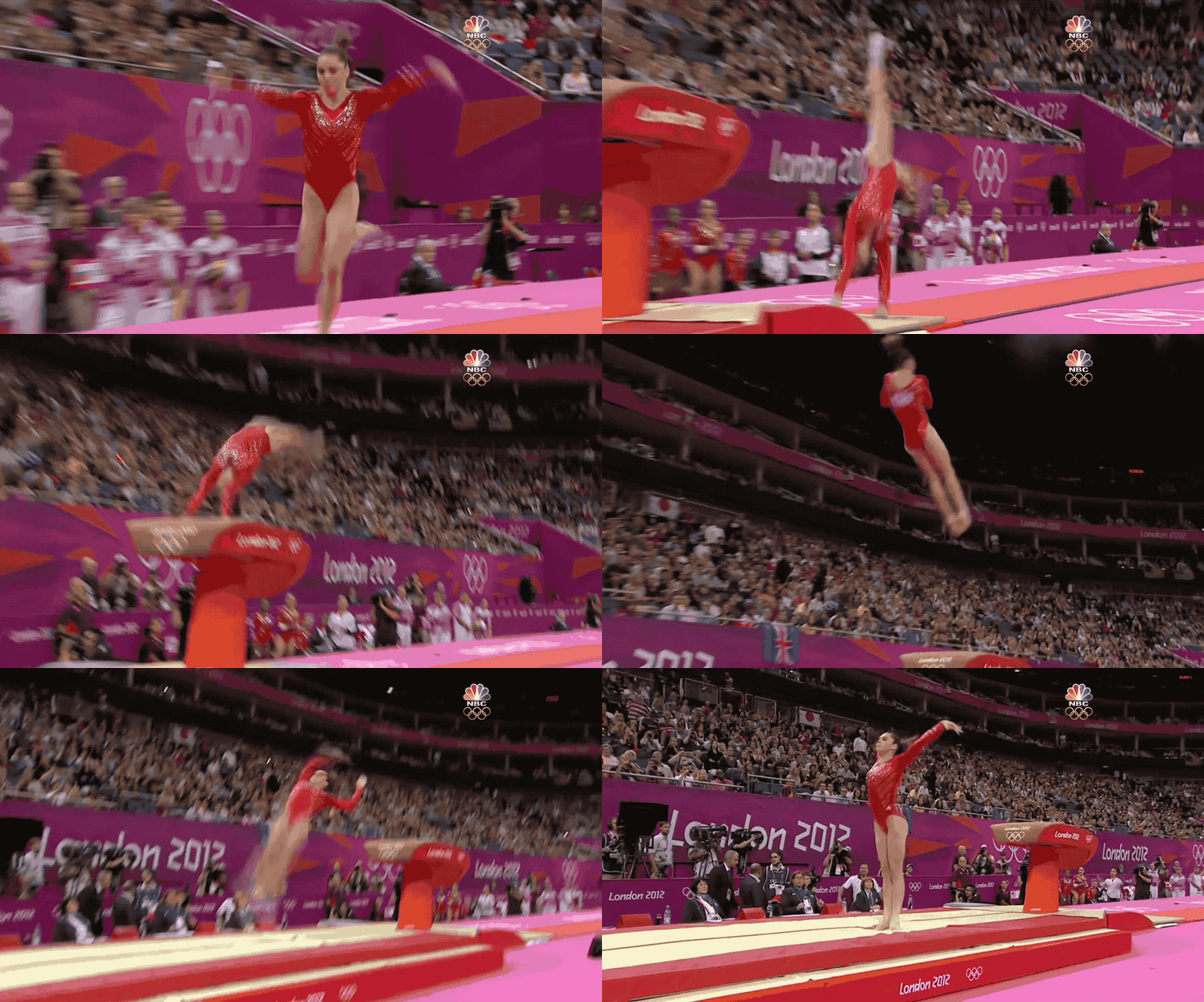
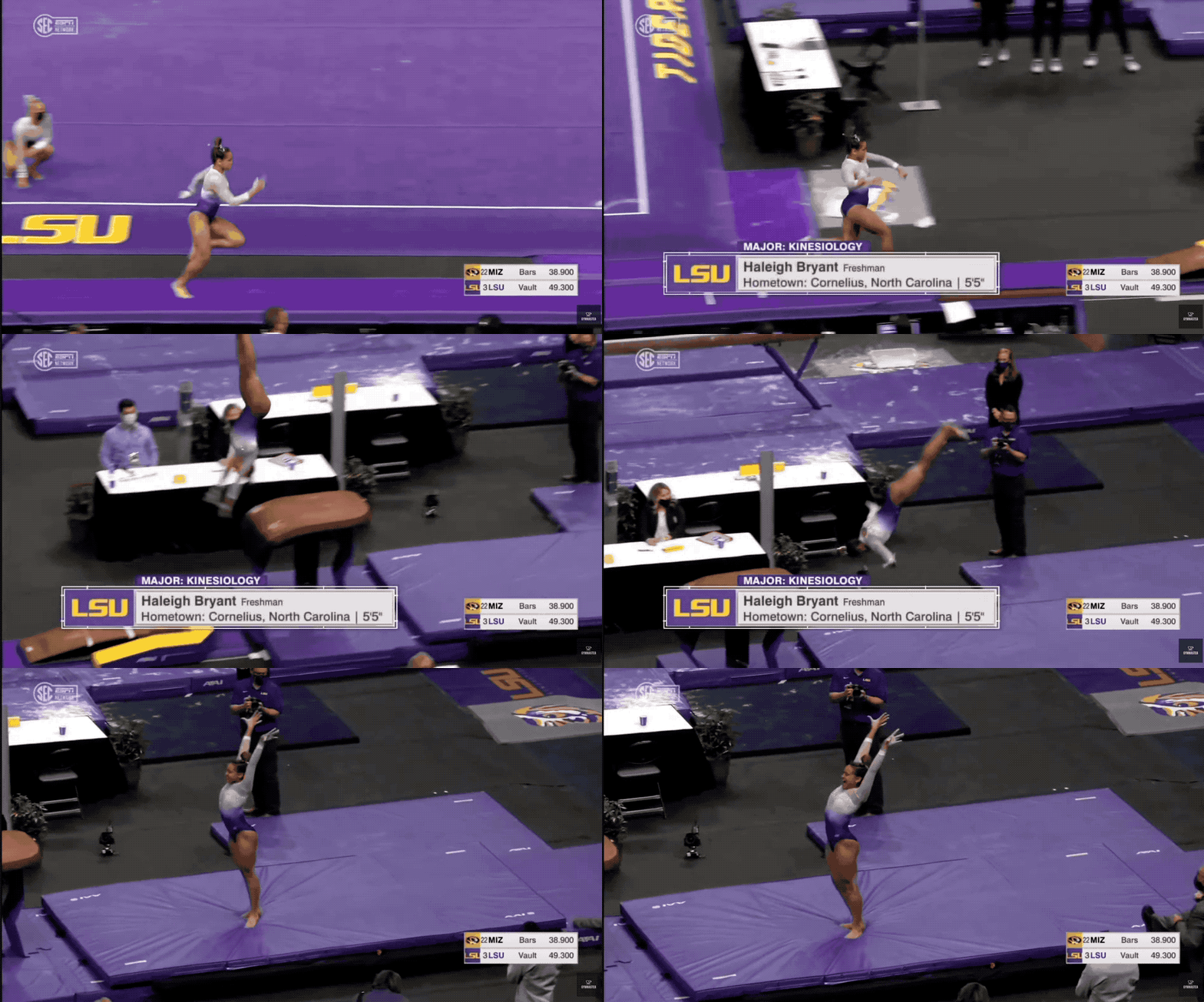
Before the NCAA season begins, it’s time for the now-annual venture into the murky world of NCAA scoring for those who might want to know a little more about what’s actually going on behind that bonkers 9.950 that just got thrown. Fair warning: you’ll be happier if you don’t
Composing a routine
Routine requirements
At minimum, an NCAA routine must include 3 A-valued elements, 3 B-valued elements, and 2 C-valued elements.
That is a basic standard that most college gymnasts are able to achieve comfortably. You don’t have to worry about it. Gymnasts must also fulfill a series of special composition requirements, each worth 0.2. On floor, those four requirements are
1 – One acrobatic combination, featuring 2 saltos. The 2 saltos can be directly connected to each other or indirectly connected to each other within a single tumbling pass, but they must appear in the same line of acrobatic skills.
2 – Three different saltos within the exercise. Because the majority of gymnasts perform three tumbling passes, one of which must be a combination pass, they tend to have four different saltos in their routines anyway, easily fulfilling the minimum requirement of three.
Some will not have four, either because they are performing a routine with just two passes, or because they are repeating a skill in one of the passes, but they must have at least three different salto elements at some point.
Before the NCAA season begins, it’s time for the now-annual venture into the murky world of NCAA scoring for those who might want to know a little more about what’s actually going on behind that bonkers 9.950 that just got thrown. Fair warning: you’ll be happier if you don’t.
Composing a routine
Routine requirements
At minimum, an NCAA routine must include 3 A-valued elements, 3 B-valued elements, and 2 C-valued elements.
That is a very basic standard that most college gymnasts are able to achieve comfortably. You don’t have to worry about it. Gymnasts must also fulfill a series of special composition requirements, each worth 0.2. On beam, those five requirements are
1 – One acrobatic series. This means two acrobatic flight elements, “directly connected,” with at least one of the elements being C value or higher.
By far the most common acrobatic flight series you’ll see is the back handspring + layout stepout (loso) series.
It’s the classic NCAA series, and you’re probably sick of it. Or you will be.
You’ll notice I put “directly connected” in quotes in the above rule because of snottiness. An acrobatic series should have to be directly connected and generate rebounding speed in one direction. But that is not actually required, and a forward + backward series may also be used to fulfill this requirement.
Before the NCAA season begins, it’s time for the now-annual venture into the murky world of NCAA scoring for those who might want to know a little more about what’s actually going on behind that bonkers 9.950 that just got thrown. Fair warning: you’ll be happier if you don’t.
Composing a routine
Routine requirements
At minimum, an NCAA routine must include 3 A-value elements, 3 B-value elements, and 2 C-value elements.
That is a basic standard that most college gymnasts are able to achieve comfortably. You don’t have to worry about it. Gymnasts must also fulfill a series of special composition requirements, each worth 0.2. On bars, those four requirements are
1 – Two separate bar changes. This means that you can’t just start on the low bar, get up to the high bar, and then dismount. At some point in the routine, you have to transition from low to high, and from high to low.
2 – Two flight elements, not including the dismount. Flight elements include same-bar releases, as well as transition skills in which the body is not in contact with either bar at some point.
Gymnasts will typically fulfill this by using their two transitions (e.g., a bail handstand and a toe shoot; a Pak and a Shaposh), or by using one of those transitions skills along with a same-bar release. Gymnasts do not have to perform a same-bar release, and you’re supposed to have a really strong opinion about that one way or the other.
The two flight elements typically must be at least C-value skills, but one B-value skill can be used to meet the requirement as long as the other element is D- or E-value.
3 – A turning element, minimum C value. Turning elements normally make us think of pirouettes, but that does not have to be the case. Turning pirouettes do fulfill this requirement, but so does any skill including at least a 1/2 turn at any point. That means a skill like a bail handstand can be used to meet this requirement. It’s not the spirit of the rule, but it does count and is taken advantage of all the time.
4 – A dismount, minimum C value. This special requirement is a lie. NCAA gymnastics absolutely does not want you dismounting with an isolated C element, despite what the requirement says.
You can, but if the C-level dismount is preceded by two giant swings, as most dismounts are, you lose 0.1. Plus, if the C dismount is not performed in combination with another element for bonus, you lose 0.1 (see “up to level” section below). So basically, you can’t dismount with a lone C.
The requirement basically should just say a dismount, minimum D value, or C-value in direct bonus combination. That’s what it boils down to anyway.
Missing any one of these four requirements is a 0.2 deduction from the start value. Every routine you watch will have been composed specifically to ensure that doesn’t happen. Any gymnast with a routine that includes 3 As, 3 Bs, and 2 Cs, and that fulfills the four requirements above will begin with a 9.40 start value.
Bonus
From that 9.40 start, gymnasts will attempt to get up to a 10.0 start value by earning six tenths of bonus. Bonus is earned in two categories.
1) Skill value -Every D-value skill earns 0.1 in bonus
-Every E-value skill earns 0.2 in bonus
-E-value releases (same-bar or transition) and D-value releases (same-bar only) receive an additional 0.1 added to the skill bonus.
2) Connection value C+C = 0.1 (but only if both elements show flight or turn, OR if both elements begin from the clear-hip, toe-on, or stalder roots)
C+D = 0.1
D+D = 0.2
To earn the full six tenths of bonus, at least one tenth must come from each category (skill value and connection value), so you can’t load up exclusively on one category or another.
But, as long as you get your six tenths of bonus, and fulfill all the requirements above, you’ve got your 10.0 start!
Up to level
Unless. There are several possible routine-composition deductions in NCAA routines, but the one you’ll hear about the most during the season is the “up to level” deduction (UTL).
This deduction is a flat .10, taken from any routine that does not fulfill the standard of being “up to the competitive level.”
What does that even mean? Good question. On bars, a routine is considered up to the competitive level, and therefore avoids this deduction, as long as it fulfills ONE of the following areas.
“Up to level” is also where that 0.1 deduction for performing a C-value dismount without connection bonus mentioned earlier comes in.
Judges must display if they have taken an up-to-level deduction on a routine. So in a meet, if you see a judge flash a card that says “UTL” next to the start value, it doesn’t mean “Urination Took Long” and she missed the beginning of the routine. It means an up to level deduction was taken.
Example
Now lets go through a fairly straightforward example routine, the co-national championship winning set from Maya Bordas, to see how she fulfills the necessary requirements and gets to a 10.0 start value.
Special requirements
1 – Two bar changes – In this routine, Bordas performs an overshoot from high bar to low bar, followed by a kip to stand on the low bar and grab the high bar, which fulfills the need for two bar changes, going from both high bar to low bar and low bar to high bar.
2 – Two flight elements – Bordas performs a straddled Jaeger (1) directly connected to that overshoot (2), fulfilling the requirement for two flight elements.
3 – A turning element, minimum C value – Bordas performs a giant swing with full turn directly before the dismount, which checks the box for a turning skill.
4 – A dismount, minimum C value – Bordas performs a double tuck dismount, which is a C value. By connecting it out of the giant full, she avoids the deduction for an isolated C dismount.
Up to level
Bordas fulfills UTL through the first option, a same-bar release:
1 – A same-bar release of D value – straddled Jaeger
2 – A release element of E value
3 – Two D releases
4 – Two E-level skills
Bonus
Bordas starts with a blind change, a C element in college gymnastics, directly connected to a straddled Jaeger, a D element. The connection of a C skill to a D skill earns 0.1 in bonus, the D skill itself also earns 0.1 in bonus, and this D skill earns an additional 0.1 for being a same-bar release. So with those two elements, Bordas has already notched 0.3 in bonus.
She goes on to connect the straddled Jaeger to an overshoot. Not to be confused with a bail to handstand, which has to reach a vertical position on the low bar, this skill is not intended to reach vertical. Typically this overshoot is a B element, but when directly connected out of D release like a straddled Jaeger, its value is bumped up to C. That means that Bordas earns another 0.1 here for connecting a D element and a C element, bringing her total bonus to 0.4.
Her remaining bonus is earned in the dismount combination, where she connects a giant full to a double tuck. The giant full is a D element, earning another 0.1 for a D skill, and the double tuck dismount is a C element, so that’s yet another 0.1 connection for a D skill + a C skill. These final 0.2 in bonus for the dismount combo bring her total bonus up to 0.6. Add that to her 9.4 base start value, and she’s up to a 10.0 routine.
Skill values
Here are the major skill values you’ll want to know for bars. Note: Links go to the elite skill database, andsome elite skill values are different from college.
The most important thing you need to know about NCAA deductions is ‾\_(ツ)_/‾. Keep that in mind at all times.
NCAA pretends that it follows the Level 10 code of points, except it obviously doesn’t. There is a tremendous amount of subjectivity remaining in NCAA scoring, including an unwritten understanding regarding which deductions from the Level 10 code actually count and which ones magically don’t for the purpose of scoring NCAA routines. The standard is, “We take the Level 10 code of points, and then just ignore all of it. The end. Here’s your score. Fetch.”
So, in these sections, I’m going to deviate from (deviate from = completely ignore) the actual code of points we’re supposed to follow or the instructional videos the NAWGJ put out each year which are a nice pipe dream and immediately forgotten by everyone and instead discuss the reality of what I see getting taken from meet to meet.
This is not an exhaustive account of deductions but rather an overview of the main things to look out for. On bars, those main things are handstands and landings. If you sometimes feel like those are the only two areas that ever get deducted on bars routines, welcome to the club.
Falls
Falls are 0.50 each time. Pretty straightforward.
Sometimes, you will see a gymnast fall on a routine and then receive a score like 8.950 and go, “Wait, the half point for the fall doesn’t account for that whole deduction-scape.” In these cases, the gymnast likely also lost connection bonus and/or skill value for falling on a compositionally critical part of the routine, so the start value was no longer 10.0.
Landings
The smallest landing deduction the judges can take is .05. This is supposed to be reserved for only the very smallest of movements, like when a gymnast allllmost sticks but her momentum forces that little slide backward, or she has that tiny hop in place where the feet don’t even really come up but it’s also not a stick. That’s what the .05 is allegedly for, though in practice what constitutes very small movement tends to be evaluated quite loosely, especially for those teams going 9.9 for every routine, and a lot of things—even discernible steps—tend to get away with just .05 instead of a full tenth.
The written rule is that if it’s a clear step, it’s supposed to be a .10 deduction, and if it’s larger than a yard, it’s supposed to be .20 for each step individually. In reality, I think we see more like .05 for a regular step and .10 for a large step.
In addition to stepping/hopping/lunging, there will be landing position deductions for issues like an egregious squat (some squatting is good to absorb a landing, but deductions come into play if the thighs are below parallel to the mat) or leaning way forward to try to hold a stick. A stuck landing does not mean the landing is free from deductions. Leaning or doing the butterfly to try to stay planted are deductions, and if the gesticulations are significantly wild, they can end up being a larger deduction (say, .10) than the small step they’re serving to avoid would have been (.05).
Lack of control is also a separate thing on landing, so if a gymnast steps once and then does that little move where she turns around and kind of bounces and salutes and never really stops moving, that can be a .05 in addition to the step.
Handstands
Handstands are THE THING on bars.
When gymnasts cast to handstand in NCAA, we’re told the judges are expecting them to be within 10 degrees of vertical to receive no deduction. This “degree” stuff is super ambiguous (the human eye cannot tell the difference between 9 degrees and 11 degrees on a handstand), so the rule basically ends up being “y’all better be vertical.”
Here is a vertical handstand for definitely, absolutely no deduction:
Meanwhile, here is a handstand that comes up 10 degrees short:
This second handstand is going to look pretty close to a vertical handstand in real time and is pretty much as far from vertical as you can go while hoping to escape without a deduction. Any further from vertical will receive a small deduction on each instance.
Much shorter than vertical will get more severely deducted and start going into full-tenth land as well as risk losing the value of the skill, but most of your “oh, she was just a little short on that handstand” issues will be .05.
We tend to focus on the vertical position when gymnasts cast to handstand, but it is equally important on pirouetting skills like a giant full. On those skills, watch the point at which the gymnast ceases turning. At that moment, the vertical position should still be maintained—and never is. Finishing a pirouette short of vertical is the same problem as casting to handstand short of vertical, though the evaluation is way more forgiving, with gymnasts allowed to finish 20 degrees past vertical for no deduction. That’s a frustration of mine because 20 degrees is verrry late to be considered deduction-free. We see a lot of late cast 1/2 turns on low bar that are escaping without deduction because you could theoretically maybe say it was within 20 degrees.
Catching short of a vertical position on a bail handstand is another a pretty common NCAA deduction.
Judges are also likely taking for bent elbows on the catch in this case because it’s pretty obvious, but bent elbows are a significant point of argument when it comes to NCAA scores and don’t get taken as often as they might be. Keep in mind that if the torso is perfectly vertical but there’s an angle in the hips so the feet aren’t vertical, that doesn’t count as vertical. The position is going to be judged by the feet, so this position probably isn’t getting credit for the skill being in handstand.
Other deductions
There are many, many other little deductions that will (or more accurately can) be taken on bars, but one of the remaining significant ones is leg separations.
This often gets ignored in NCAA because the judges can’t necessarily see leg separations from the side view—and are also probably looking right up into the arena lights. But, the legs are supposed to be pasted together on pirouettes, transitions, and dismounts—basically for the entire routine unless you’re performing a release element with straddle or straddling up to handstand. If the legs lose contact with each other unintentionally, that’s a deduction—typically a .05 unless we’re verging into crazy-legs territory, where one of the legs looks like it’s about to fly off, then it can be more.
So, if the legs flash apart for a second on top of the bar in the middle of a full turn, or you see daylight between them on a bail handstand or double layout dismount, or the two legs are in uneven positions in the air on a full-twisting double tuck dismount, those are all going to be .05 deductions.
The knees are also expected to be perfectly straight on bars at all times. Basically, the legs should be forming a straight line throughout the entire routine unless it’s during a tucked dismount.
A major source of potential leg form deductions are giant swings before the dismount, where softening the legs as they pass by the low bar can be a .05. Sometimes a gymnast will ditch the traditional two giants before her dismount if she can, even though it doesn’t do anything for her start value, and you think, “well then…for why?” and it’s probably because her leg position on giant swings is a deduction trap.
Flexed feet is another point of contention when it comes to NCAA judging. Ideally, the feet should be pointed at all times during a routine. See the first handstand image above. That’s what we’re looking for.
In reality, my impression is that flexed feet aren’t really getting deducted if the feet become flexed on, say, a single challenging same-bar release skill. But, if the foot flexion is pronounced and present throughout the routine, a small overall deduction will be taken.
Lack of amplitude is another key area of possible deduction. If a release skill or dismount is flat (e.g., a Tkatchev that clears the bar by only an inch or two, a Jaeger or dismount where the hips don’t rise above the height of the bar in flight), it should be deducted.
On the topic of amplitude, another deduction you’ll see on releases relates to catching close. A gymnast intends to catch a same-bar release with extended elbows, maintaining the same rhythm through to the next element. Catching too close to the bar, typically with bent elbows, impedes that rhythm and typically shows up in a stall/pause or a muscled cast handstand out of the skill.
This can be hit pretty harshly in terms of the form errors on the actual catch, the form errors that will inevitably ensue as the gymnast tries to get back on track, as well as a general break in the rhythm. Bars routines should show continuous rhythm in the swing. All these little deductions add up.
Being too close to the bar can be a problem on dismounts as well. As on vault, the gymnast intends to go both up (hips over the height of the bar) and out (so that your foot—or face—doesn’t almost clip the bar). Coming terrifyingly close to hitting the bar on the dismount is a deduction because of terrifying.
Keep in mind a tendency in NCAA to judge holistically, taking into account the overall sense of a routine. If a judge sees a little bent elbow rhythm hesitation coming out of a toe-on skill, then some small leg separations in giant swings before the dismount, but nothing else to deduct, they may take all of that into account and simply say, “OK there were 2 or 3 things that are borderline deductions, none of which I HAVE to take as a pure .05, but that also combine to mean this wasn’t a 10. So, I’m going to give it 9.950.”
That’s the level of subjectivity we still have in NCAA gymnastics, which can be frustrating to those familiar with the elite code or who want specific receipts of all deductions to maintain transparency and continuity across all judges. It’s not going to happen any time soon. YOU’RE WELCOME.
Before the NCAA season begins, it’s time for the now-annual venture into the murky world of NCAA scoring for those who might want to know a little more about what’s actually going on behind that bonkers 9.950 that just got thrown. Fair warning: you’ll be happier if you don’t.
Vault values
Unlike on the other events, where we have skills and letters values and composition requirements and bonus rules, on vault we simply have a set of predetermined start values.
You can check out the full list of vaults and their values, but the most pressing issue on vault is the quest to have a 10.0 start value. Because the omnipresent Yurchenko full is valued at 9.95, having a 10.0 SV can provide a decisive advantage. A lineup of all 10.0 vaults would begin with a margin of .250 over a lineup of all Yurchenko fulls.
Here is a list of some 10.0-value vaults that you may or may not see in NCAA. The golden geese of vaulting.
With the values set, all we have left to deal with are the deductions. Just those. The most important thing you need to know about NCAA deductions is ‾\_(ツ)_/‾. Keep that in mind at all times.
NCAA pretends that it follows the Level 10 code of points, except it obviously doesn’t. There is a tremendous amount of subjectivity in NCAA scoring, including an unwritten understanding regarding which deductions from the Level 10 code actually count and which ones magically don’t for the purpose of scoring NCAA routines. The standard is, “We take the Level 10 code of points, and then just ignore all of it. The end. Here’s your score. Fetch.”
So, in these sections, I’m going to deviate from (deviate from = completely ignore) the actual code of points we’re supposed to follow or the instructional videos the NAWGJ put out each year which are a nice pipe dream and immediately forgotten by everyone and instead discuss the reality of what I see getting taken from meet to meet.
This is not an exhaustive account of deductions, but rather an overview of the main things to look out for. Since only 1 element is being performed on vault instead of the normal 8, there are theoretically fewer areas in which to take deductions. As a result, deductions for issues like body position on landing or a fake stick—things that might be forgiven at the end of a bars routine if they’re minimal—are less likely to be forgiven on vault. So let’s start with those landings.
Landings
The smallest landing deduction the judges can take is .05. This is supposed to be reserved for only the very smallest of movements, like when a gymnast allllmost sticks but her momentum forces that little slide backward, or she has that tiny hop in place where the feet don’t even really come up but it’s also not a stick. That’s what the .05 is for, though in practice what constitutes very small movement tends to be evaluated loosely, especially for those teams going 9.9 for every routine, and a lot of landing issues—even discernible steps—tend to get away with just .05 instead of a full tenth.
The written rule is that if it’s a clear step, it’s supposed to be a .10 deduction, and if it’s larger than a yard, it’s supposed to be a flat .20 for each step individually (maximum .40). Like anyone is out there with a yard stick. In reality, it often ends up taking more like a “bouncing forward into the next state” kind of landing to get any kind of significant deduction. The only way to avoid any landing deduction at all is by sticking.
What is a stuck landing? A stuck landing is when the feet hit the ground and then do not move at all in any way. That—and only that—is a stuck landing. A small rebound upward in place is not a stick, and “stuck landing” is not a synonym for “good landing.” Do not do that. A stick is an actual specific thing.
So, what is a “college stick”? College stick is a term invented by grimy little jackals like me to describe the situation where a college gymnast—fully of newly adult savvy and three days of Acting I before she dropped it because there’s no way she could maintain that schedule—will realize that there is zero chance in the holographic universe that she’ll be able to hold her landing under control for any length of time, so she just pretends like she already stuck hours ago and you simply missed it. Like when your parents would ask whether you washed your hands before dinner and you were like, “…yes.” The gymnast will land and then pretend like the absolutely necessary step she physically had to take afterward is merely a post-stick celebration, just like all the cool kids do after their definitely real sticks that happened. This is not a stick.
“Landing short”—for instance, not completing the full flip on a Yurchenko full and therefore coming into the mat with a piked angle in the hips and the chest too far forward—will be deducted in addition to any ensuing step, so gymnasts in those cases aren’t getting away with just the .05/.10 step deduction, there’s supposed to be an extra .10 added onto the step deduction for a short landing, he said sarcastically.
That’s why you will typically see (or should see) Yurchenko fulls with a step forward score lower than Yurchenko fulls with an equivalent-sized step backward. The vault with a step backward will have been fully completed and landed with the chest up, so would then incur only the step deduction. The vault with a step forward, however, was not 100% completed because the step forward indicates that the gymnast came into the mat short, probably having to pike down and lose the layout shape as well. All of which are additional deductions.
Piked shape and bent knees
Most vaults you see in NCAA will attempt a layout position. On those vaults, the best athletes will show a completely straight body shape throughout, like a muscly little broomstick. Ideally, gymnasts will go even further than that and show a slightly open shape with a little arch toward the end of the vault, going beyond the straight position just because they can, Shannon Miller-style.
If performed in NCAA, the above vault should receive a perfect 9.950 (the maximum for a Yurchenko full).
You’ll hear about the best vaulters “flaring” a vault, which means they’re opening and extending their arms at the end to slow their rotation coming in for landing. This both looks pretty and provides evidence of a gymnast who has way more than enough time to complete her vault and land in a non-Hunchback-of-Notre-Dame shape, so she has to slow herself down to avoid overdoing it.
Those who exhibit a closed hip angle—less than 180 degrees—on a layout vault will face a deduction. This is typically a small deduction, depending on the degree of the angle and when it occurs. If the pike is significant or present throughout the entire vault (not just coming in for landing), gymnasts will be docked more than .05. When the chest is just a little bit too forward on landing at the very end but everything else is fine, that often escapes without a deduction.
When a gymnast could eat a full dinner off her knees on landing, that’s when body position becomes a major problem and moves into .10+ territory.
Vaults that are intended to be piked are held to a similarly strict shape standard, but in their case the requirement is showing a 90-degree hip angle instead of 180. Tucked vaults need to show less than a 90-degree hip angle and less than a 90-degree knee angle.
Both layout and piked vaults are expected to exhibit straight legs, without any bent knees or hint of vestigial tucking. A “soft” position means the legs have a little bend in the knee throughout, which is typically a .05 but can increase based on severity.
Amplitude
Height/amplitude is evaluated far more critically on vault than on the other events. Gymnasts need to show repulsion off the vaulting table (going UP and OUT, not just out) and need to complete the vault while still in a high position in the air. Otherwise, they’ll come in short and be in line for the landing deductions discussed above, as well as an amplitude deduction. Deductions don’t exist in a vacuum. One creates the next.
There is no specific height standard that gymnasts are expected to reach. Instead, a vault that avoids an amplitude deduction is one where the entire vault, all necessary flipping and twisting, is completed with at least the chest, if not the entire body, above the height of the vaulting table. Then, as the gymnast passes the height of the vaulting table, all she has to do is prepare for landing.
The height deductions get quite intense for flat vaults that shoot out horizontally. These are not the little .05s we see for minor form breaks. A vault that lacks height is considered a much more significant error than a vault with soft knees or small landing movement. The judges are actually able to take up to .50 for height, which they never come close to because college scoring, but there’s a lot more freedom to deduct for height.
Meanwhile, “heighth” is not a word.
Distance
As mentioned above, vaults are expected to go both UP and OUT, so a vault that goes only up—and not out very far from the vault—will be deducted with nearly the same severity as one that goes only out, and not up.
Distance, too, is judged without a specific reference point, despite how easy it would be to put a line on the vault mat if someone actually wanted to. This makes distance deductions pretty ambiguous. “Did she go far?” is not an acceptably distinct standard for judging, but that’s more or less where we are.
Basically, gymnasts are expected not to make the judges scared that they’re going to hit their head on the vaulting table. If a judge screams at your vault, that’s probably bad. At minimum, gymnasts need to be far enough away that hitting themselves on the vault cannot physically happen. Ideally, a gymnast would have enough room to be able to lie down flat on the mat between her landing position and the vault. You know, a really scientific standard.
Direction
Gymnasts are expected to land in line with the center of the vaulting table, not deviating too far to either side. In elite, the vaulting mats have guidelines for the judges to be able to evaluate this. They do not in NCAA, once again because of helpfulness.
For that reason, the direction deduction is taken less frequently in NCAA than it should be, or would be if there were a specific guide on the mats. Vaults that start veering to one side or another, as long as it’s not too egregious, often escape without deduction. But technically, there should be a penalty there. Unlike in elite, where a gymnast stepping out of the area after landing is deducted, college gymnastics evaluates direction based only on where the gymnast initially lands, not where she then steps.
Leg separations
Also on the topic of deductions that are not evaluated as harshly as they could be in NCAA gymnastics, leg separations on vault. The legs are supposed to be pasted together in the air on all vaults. To be actually deducted in college, however, leg separations must occur in post-flight (after leaving the vaulting table) and be somewhat obvious—i.e., we’re seeing actual daylight between the legs.
A minor crossing of the feet in the air is one of those things that’s technically a deduction but will be forgiven without penalty in college gymnastics, as will basically any and all deductions in pre-flight (the time between hitting the springboard and contacting the table) or in repulsion (the time when in contact with the vaulting table), except for perhaps an egregious back arch. Typically, the excuse is the position in which the judges are sitting, from which they cannot see straddled legs on the table. Then maybe the judges should sit in a better position.
A similar approach is taken to shoulder angles and bent elbows on the vaulting table (the arms and trunk should create straight line in every viewing plane), which tend to be only theoretical deductions. They aren’t deducted as much as they could be in and of themselves, though issues like that typically lead to a lack of amplitude and distance, which is where gymnasts will be penalized.